Metal Building Systems: Design and Specifications, Second Edition
Metal building systems represent one of the youngest and most dynamic sectors of the construction industry. New materials and design applications of metal buildings continue to emerge, expanding the architect s palette of choices. This chapter examines some latest trends in specifying metal buildings, a few winning design solutions, and factors that further increase competitiveness of pre-engineered buildings.
As metal building systems expand their acceptance into commercial, institutional, and community environments, the old bland, utilitarian look of metal-sheathed gable buildings gives way to more interesting and diverse design solutions. Visual interest can be added not only by the wall materials discussed in Chap. 7 but also by various facade treatments ranging from basic canopies to sophisticated fascia panels.
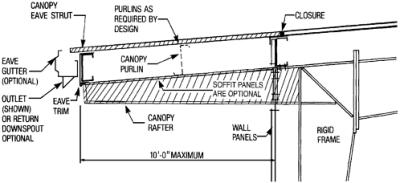
A functional and aesthetically pleasing canopy is perhaps the most common facade treatment. The simplest way to build a canopy is to provide a cantilevered extension of the primary frame at the eave level and to continue the roof framing onto the canopy (Fig. 13.1). The eave-line canopy is most appropriate for continuous and wide up to 10 ft canopy coverage that extends the full length of the building. For this solution to work, the building exterior must be visually compatible with exposed cantilevered rafter framing, which stays in full view even when soffit panels cover the underside of the canopy s roofing.
A more refined option is a flush-framing canopy, where all the framing is hidden from...