Microfluid Mechanics: Principles and Modeling

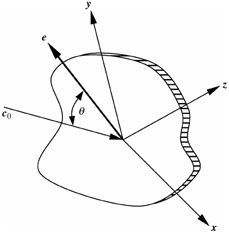
The flux of molecular quantities across a surface element is considered in an equilibrium gas. The stream velocity c 0 is inclined at the angle ? to the unit normal vector e to the surface element, as shown in Fig. 5B.1. Without loss of generality, Cartesian coordinates are chosen such that the stream velocity lies in the yz-plane, with the x-axis in the negative e direction.
Each molecule has velocity components
| (5B.1) | |
The flux of quantity Q across the surface element along the positive x-direction is
| (5B.2) | |
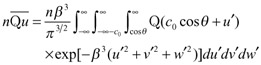
For an equilibrium gas, the Maxwellian distribution function f 0 is substituted into Eq. (5B.2), and the Q-flux across the element per unit area per unit time can be obtained as
| (5B.3) | |
The number flux
of molecules across the surface element is obtained with Q = 1 in Eq. (5B.3).
| (5B.4) | |
where
| (5B.5) | |
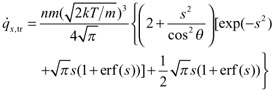
The translational energy flux
to the element is obtained by setting Q =
mc 2 in Eq. (5B.3) to give
| (5B.6) | |
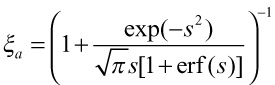
And the averaged translational energy per molecule crossing a surface element is obtained through dividing Eq. (5B.6) by Eq. (5B.4) to give
| (5B.7) | |
where
| (5B.8) | |
Comparing with kinetic theory equation
for all the molecules in an equilibrium state with mean flow velocity c 0 and temperature