Microfluid Mechanics: Principles and Modeling

Numerical solutions of a number of microfluid flow cases are presented in this chapter. Results obtained by using both the continuum as well as the discrete approaches will be presented, discussed, and, when possible, compared. The classical problems of the Couette and Poiseuille flows will be used. This allows us to prime the reader with some of the fundamental differences between low-speed microflows and those at macroscales by simple analyses before the numerical solutions are introduced.
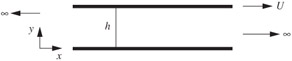
The geometry of the microCouette flow is simple. The flow develops between two infinite parallel walls. The top wall moves at a constant speed and the lower surface is stationary. Without considering other physical forces, such as electrical and magnetic forces, the wall shear provides the driving mechanism. The flow is a classical problem in continuum fluid mechanics. In microscale devices, the flow is also representative of many flows seen in microfluidic devices, such as micropumps, microbearings, and micromotors. In this section, we will examine its analytical solution in the slip-flow regime and discuss the resulting corrections to the continuum solution due to the finite Knudsen number.
The flow geometry is shown in Fig. 9.2.1. The flow is assumed homogeneous in the z-direction and, therefore, two-dimensional. As in the continuum problem, solutions will be sought when the flow has become steady and fully developed in its velocity profiles. Without losing generality, the fluid will be assumed incompressible. The Navier-Stokes equations become