4.5 GENERAL BIQUADRATIC REALIZATIONS WITH MULTIPLE-OP AMP BIQUADS
A single-op amp realization of a general biquadratic transfer function [Eq. (4-63)] using the Friend circuit was shown in Section 4.3. In this section we show how easily a general biquad can be realized by simply using a summing amplifier and any one of the three-op amp biquad circuits in previous sections.
As an example, let us consider the KHN network shown in Fig. 4-31, which we noted earlier has low-pass, band-pass, and high-pass outputs simultaneously available at terminals V 1, V 2, and V 3, respectively. Thus, if we simply sum these outputs, modified by the appropriate gain and sign, we obtain the desired general biquadratic transfer function:
| (4-109) | 
|
where V 1, V 2, and V 3 are given in Eqs. (4-81) to (4-83) and ? 1, ? 2, and ? 3 are summer gains with appropriate sign. The schematic for general KHN realization is given in Fig. 4-36. Its transfer function is given by
| (4-110a) | 
|
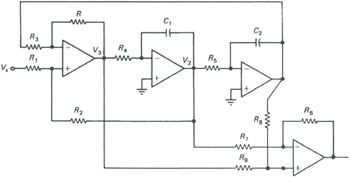 Figure 4-36: General biquad with feedforward paths.
 where K 1 = 1 + R/R 3, K 2 = 1 + R 1 /R 2 , K 3 = 1 + R 6/ R 7, and K 4 = 1 + R 8/ R 9; D( s) is given in Eq. (4-85); and
| (4-110b) | 
|
Recall from Eqs. (4-87) that
| (4-111a) | 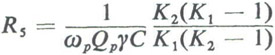
|
| (4-111b) | 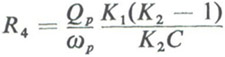
|
where K 1, K


 TABLE OF CONTENTS