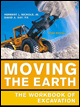
Moving the Earth: The Workbook of Excavation, Fifth Edition
Part 1: THE WORK

Chapter 1: LAND CLEARING AND CONTROLS
Chapter 2: SURVEYS AND MEASUREMENTS
Chapter 3: ROCK, SOIL, AND MUD
Chapter 4: BASEMENTS
Chapter 5: DITCHING AND DEWATERING
Chapter 6: PONDS AND EARTH DAMS
Chapter 7: LANDSCAPING AND AGRICULTURAL GRADING
Chapter 8: ROADWAYS
Chapter 9: BLASTING AND TUNNELING
Chapter 10: PIT OPERATION
Chapter 11: COSTS AND MANAGEMENT

MACHINES AND WORKERS

Clearing of vegetation is usually necessary and almost always desirable as a preliminary to moving or shaping ground. Any growth makes dirt or rock difficult to handle, and its decay will cause settlement of fills. To satisfy environmental concerns during construction, a building site must be surrounded by silting fencing. This is plastic sheeting several feet high to prevent silt material from being carried off the site by rain or wind onto neighboring property.

Some clearing of growth heavier than grass or weeds is done almost as an end in itself, for agricultural purposes. It makes possible replacing woods and brushlands with pasture, crops, or tree farms.

Clearing is preferably a machine job. It may be done by a wide variety of standard excavators, particularly by bulldozers, front loaders, and backhoes. But if the job is large and/or difficult, it will probably pay to buy or rent one or more of the specialized clearing machines or attachments discussed in Chap. 21.

However, hand labor may be used in addition to or instead of machine work. A small piece of equipment may be able to do the work of a much larger one if...

UNLIMITED FREE
ACCESS
TO THE WORLD'S BEST IDEAS

SUBMIT
Already a GlobalSpec user? Log in.

This is embarrasing...

An error occurred while processing the form. Please try again in a few minutes.

Customize Your GlobalSpec Experience

Category: Excavating Services
Finish!
Privacy Policy

This is embarrasing...

An error occurred while processing the form. Please try again in a few minutes.