2.2. Bars
Let us set aside strings and now consider the case of a rod or of a bar, with a circular or rectangular section. This is the vibration source for many instruments, such as the accordion, the xylophone (Greek for 'sound of wood'), the vibraphone (a xylophone with metal bars (!), with the addition of tubes that work as resonators and a rotating valve device to modify the amplitude periodically), the celesta (rods struck by a hammer), the Fender Rhodes piano (likewise), music boxes, etc., and in wind instruments, the reed itself!
As was the case with strings, there are several possible types of vibrations, and we will focus on transverse waves in an xOy plane, where the central axis of the bar has its ends at points (0,0) and (0, L). The position of the axis at a time t is given by the equation y = u( x, t). The mechanics model is more complex than with strings, and we will admit that the movement of the bar is governed by the equation
where g is the gyration radius which depends on the shape of the bar's section [3], 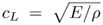 is the propagation speed of the longitudinal waves through the bar, E is the elastic modulus of the material and ? its density. The harmonic solutions are still of the form
but ?( x) is now a solution to a fourth-order differential equation:


 TABLE OF CONTENTS