Music and Acoustics: From Instrument to Computer

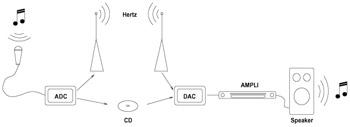
Generally speaking, an analog signal is a signal produced by a mechanical or electronic device. For such a signal, the variable is time, which elapses continuously. Just a few decades ago, any sound production chain was completely analog. For example, the sound produced by the musicians, the electrical signal delivered by the microphones, the signal transmitted by radio waves or engraved onto a phonograph record, the signal received and amplified by your stereo system and finally the sound produced by the speakers, all these are analog signals.
With the tremendous advances in computer capabilities, a new link has appeared in the chain: digital sound. Once the sound is captured by the microphone, it is transformed into a sequence of binary numbers (made of 0's and 1's), which are transmitted, stored or engraved in that form. The device that operates the conversion is called an analog-to-digital converter (ADC). It actually performs two distinct tasks on the analog signal s( t):
the sampling, which consists of measuring the values s n = s( n ?) of the analog signal at regularly spaced intervals of time 0, ?, 2 ?, 3 ?, where ? is called the sampling period. The standard sampling frequency F e = 1/ ? for audio CD's is...