Nanophotonics

A one-dimensional photonic crystal is a one-dimensional virtual medium, whose optical index shows periodic modulation (and it should not be viewed as a real object with reduced dimensionality in the real 3D world, as described in section 1.2.4).
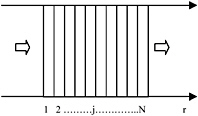
This imaginary configuration corresponds approximately to the practical situation of a periodic layer stack whose lateral dimensions are large as compared to its spatial period, given that the only relevant direction of propagation is normal to the layer plane.
Dielectric layer stacks have been around for quite some time and have been widely used and developed in optics during the last few decades to control optical signals. Modeling tools are available for the design of these periodic structures, which are based on the resolution of Maxwell equations using the so called matrix transfer technique (MAC 86). It consists of the determination, step by step, of the reflected and transmitted components of the electromagnetic field at successive interfaces and within different layers. The Bragg mirror is a famous example of such a stack layer: it consists of a periodic stack of quarter-wavelength dielectric layers, with a different optical index. It is found that this structure behaves like a mirror when operating at the configuration wavelength: reflectivity increases with the number of pair layers, and for a given number of layers, with the optical index contrast between adjacent layers. The bandwidth of the reflector also increases...