The New McGraw-Hill Telecom Factbook, Second Edition
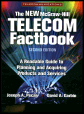
A plain-English guide anyone can use to plan and acquire telecommunications products and services!
 TABLE OF CONTENTS
 The previous chapter covers how all types of guided and unguided media are arranged to provide circuits between telecommunications network nodes and devices. This chapter amplifies earlier references to multiplexing, that is, techniques that at transmitting nodes combine a number of individual communications channels into a common frequency band or a common bit stream for transmission, usually over single circuits. At receiving terminals, demultiplexing equipment or processes separate and recover the individual channel components of multiplexed signals. Multiplexing makes more efficient use of transmission capacity to achieve a low per-channel cost.
In theory, the dimensions of space, time, frequency or code division, separately or in combination, can be employed to keep individual channel signals from interfering with each other. Accordingly, these are the dimensions upon which alternative multiplexer designs are based. Although purists would maintain that space division may legitimately be used to describe a form of multiplexing, in essence with space division, a separate wire, fiber optic strand, or radio frequency link (that is a separate circuit) is assigned to each channel or signal. Practically speaking then, space division multiplexing means no multiplexing at all.
As a consequence, there are three basic multiplexing methods used in telecommunications systems. These are frequency division multiplexing (FDM), time division multiplexing (TDM), and code division multiplexing, all of which are treated in this chapter. As explained further below, wavelength division multiplexing (WDM), introduced in the fiber optic media discussion, is...