The New McGraw-Hill Telecom Factbook, Second Edition

A plain-English guide anyone can use to plan and acquire telecommunications products and services!
 TABLE OF CONTENTS
 This part describes data services and the underlying customer premises equipment (CPE) and network facilities that support them. As in the voice section, we identify and describe high-interest services first, and then present details of salient facility technologies used to implement them. At the highest levels, the taxonomy of data services, shown in Figure P4.1, closely resembles the categories comprising voice services. By industry convention, the treatment of data services introduces some new terms to the telecommunications lexicon, namely the formal distinction among local, metropolitan, and wide area networks LANs, MANs, and WANs. IEEE definitions and the rationale concerning why they are generally applied in data communications but not in voice communications network discussions are explained in Chapter 14. Two categories of services, application service provider (ASP) services and security/public key services, although not unique to telecommunications, are so crucial to Internet and Internet-based virtual private networks, that they merit the special treatment afforded them below.
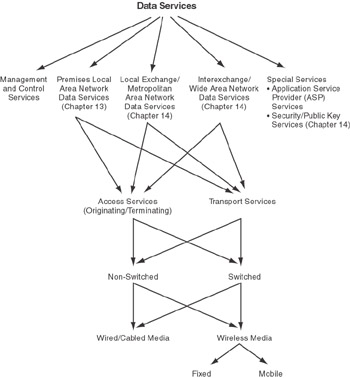
To form a more complete understanding of modern data communications services and technologies, it is helpful to understand predecessor limitations and to review the evolution of facility capabilities and user requirements that prompted their development
To place data communications system design trends in perspective, it is instructive to...