The New McGraw-Hill Telecom Factbook, Second Edition

A plain-English guide anyone can use to plan and acquire telecommunications products and services!
 TABLE OF CONTENTS
 In Chapters 1 7, we have covered a great deal of the telecommunications' landscape. Chapters 1 and 2 presented terminology, basic definitions and background material. Chapters 3 through 7 furnished descriptions of underlying concepts, techniques, and devices first, followed by explanations of what might best be described as "pillars of the telecommunications structure," namely its transmission, multiplexing, circuit switching, packet switching, frame relay, cell switching, and related management and signaling and supervision control mechanisms.
For each individual technology, these discussions systematically defined and explained salient technical and operational characteristics, important business applications, relevant standards, and major vendors and products. But it is pedagogically difficult, if not impossible in initial explanations, to impart (1) how such a large array of technologies interrelate or (2) how the technologies can be intelligently integrated to form responsive, reliable, and cost-effective composite telecommunications systems.
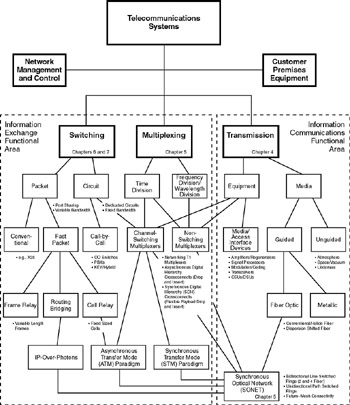
However, armed with an understanding of the telecommunications industry's unique vocabulary and knowledge of the operation of its major constituent elements, Figure 8.1's graphical representation now affords a means of gaining broader insight in these two important areas. First, with the amplifying discussion below, the figure not only depicts how and why individual technologies constitute alternative and complementary components in today's telecommunications systems, it also promotes a better appreciation of factors that drive the evolution of individual technology developments.
Chapter 1 defined telecommunications as any process that enables one or more users (persons or machines) to pass to one...