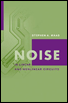
Noise in Linear and Nonlinear Circuits

Analysis of noise in linear circuits is probably the subject of greatest interest in low-noise design. In this chapter, and in contrast to the treatment in Chapter 3, we approach the subject from a circuit, rather than a system, viewpoint. Much of the basic work in this area was performed quite a long time ago, so the chapter draws heavily on the work listed in the references, especially [5.1 5.3]. The methods are designed mainly for efficiency in performing noise analysis by computer, as this is the primary application of the theory.
In Chapter 2 we saw that noise can be generated by a number of different mechanisms: thermal noise, shot noise, flicker noise, and so on. In this chapter, we are not concerned with the physical source of the noise, but instead we need only know that it exists. In all cases, we deal with a narrow spectral segment of high-frequency, white noise. Generally, that noise is modeled as a current or voltage source. Each source may be correlated with one or more other sources, which are not necessarily of the same type.
The white-noise assumption is not particularly limiting. The bandwidth of interest can always be made narrow enough to make the noise spectral density constant. In many cases, that bandwidth may be as narrow as 1 Hz, but in general it will not be stated explicitly; noise quantities in this chapter can generally be viewed as spectral densities, or, if the reader demands something more...