Noise in Linear and Nonlinear Circuits

6.3: NOISE IN NONAUTONOMOUS CIRCUITS

6.3 NOISE IN NONAUTONOMOUS CIRCUITS

The analysis of noise in nonautonomous circuits is not unlike the calculation of conversion loss in a mixer. A conversion matrix is used to linearize the circuit around its large-signal operating conditions, and the small-signal noise is treated as an excitation. We must find the correlation matrix of the noise at the output port; the mean-square noise output voltage or current is simply one component of that matrix. With this information, the noise output power is easily calculated and converted, through the relations in Chapter 3, to a noise temperature or noise figure.

6.3.1 Noise Source Correlation Matrix

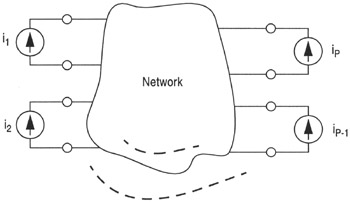
Figure 6.4 shows the problem we address. The figure shows a circuit, described by a nodal admittance matrix, and a number of modulated noise sources connected to some, but not necessarily all, of the nodes. We could include among these sources simple, unmodulated noise sources, such as those associated with an ordinary resistor. From (6.74), the correlation matrix of such a source is simply a diagonal. (We address the problem of including correlated linear sources momentarily.)


Figure 6.4: Illustration of the noise-analysis problem. The network is a linearized, time-varying nonlinear circuit, excited by the circuit elements' noise sources, a collection of both modulated and unmodulated sources.

The correlation matrix of each source, C ip, is given by (6.72) to (6.74), where p is the port number. The complete correlation matrix of the full set of sources in Figure 6.4, C s, P, is

UNLIMITED FREE
ACCESS
TO THE WORLD'S BEST IDEAS

SUBMIT
Already a GlobalSpec user? Log in.

This is embarrasing...

An error occurred while processing the form. Please try again in a few minutes.

Customize Your GlobalSpec Experience

Category: Noise Meters
Finish!
Privacy Policy

This is embarrasing...

An error occurred while processing the form. Please try again in a few minutes.