3.1 Introduction
In the last chapter we have considered the case when the system is damped and driven at the large scales. We discovered that a large coherent structure emerges. Now we consider the case without external forcing, i.e. the freely decaying quasi-geostrophic equation
where
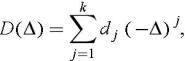
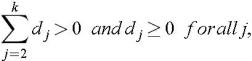
with
i.e. we assume the presence of Newtonian viscosity, or hyper-viscosity, or both.
It is apparent that all solutions converge to zero as time approaches infinity. To illustrate this point, we consider the special case of (3.1) with only Newtonian viscosity,  ( ?) = d 2 ? ?. Then the energy
  and the enstrophy
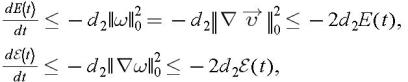
  satisfy
where we have applied Poincar s inequality, 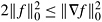 , for periodic functions with zero mean in the above. Now, Gronwall s inequality yields
which demonstrates the exponential decay of solutions. Here, we would like to study in detail how solutions decay. We are particularly interested in the emergence of large-scale coherent structures.
Early numerical investigation of the evolution of coherent structures for freely decaying 2-D Navier Stokes flows indicated that the enstrophy decays much more rapidly than the energy. This suggests that we might find a suitable intermediate time scale over which the energy changes slightly, so as to be regarded as nearly conserved, while the enstrophy sweeps down much more sharply. This led physicists to hypothesize the following selection principle to characterize the large time asymptotic states of the flow:
Physicist s selective decay principle: After a long time, solutions of the quasi- geostrophic equations and/or the two-dimensional incompressible Navier Stokes


 TABLE OF CONTENTS