The purpose of this Appendix is to prove claim (16.120) from section 16.3.
We need to postulate the following assumption:
Assumptions: d > 0 and P 2 ? 0 is uniformly bounded in time.
Remark: The first condition is equivalent to saying that there is real dissipation in the system. The second condition is satisfied provided that  0 is uniformly bounded in time.
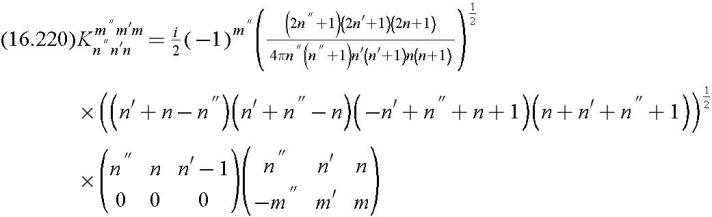
In order to prove the smallness of  we have to deal with the interaction term between different surface spherical harmonics. This is not a trivial task. We recall from Jones (1985, page 180), formula (46), that the Euler s equation on the unit sphere can be written in the form in terms of the coefficients of the surface spherical harmonics
where (see Jones, 1985, page 175, equation (30))
? = ? ? is the vorticity [ ], and there are restrictions on the summation indices which must satisfy (see Jones, 1985 page 193)
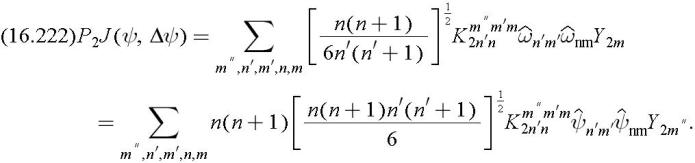
Since the non-linear term in Euler s equation is J( ?, ? ?), we must have
We may then identify the contribution from different sources
-
Contribution from the interaction between the first shell and the second shell. This must correspond to
-
Contribution from the interaction between the second shell and higher modes
-
Contribution from the interaction between higher modes ( ? 3),
-
Contribution from the interaction of the ground energy shell and higher modes (


 TABLE OF CONTENTS