8.1 Introduction
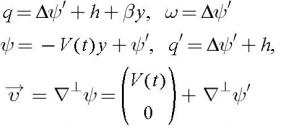
In this chapter we set-up statistical mechanics and apply the theory from Chapter 7 to suitable truncations of the barotropic quasi-geostrophic equations without damping and forcing
where
and ? = [0, 2 ?] [0 , 2 ?] is the region occupied by the fluid.
Recall that, in the empirical theory introduced in Chapter 6, we postulated empirical one-point statistics which have no direct relationship with the dynamic equations (8.1). In this chapter we build an alternative theory, involving complete statistical mechanics, based on the work of Kraichnan (1975) for ideal fluid flow, and the work of Salmon, Holloway, and Hendershott (1976) for quasi-geostrophic flows. In this alternative approach, we will build a time-dependent transport theory, inherited from the dynamic equations (8.1), considering all the correlations of fluctuations and, finally, we derive the most probable state as well as its mean state.
This alternative approach has more traditional features, i.e. it has a keen analogy with the traditional statistical mechanics for the physical objects like ideal gas particles. In the traditional statistical mechanics for gas particles, finite particle systems are considered, and then the limiting procedure, called thermodynamic limit, is taken to reveal the limit behavior of the systems. The concepts like ensemble or ensemble average, which we did not use in the empirical theory in Chapter 6, are indispensable to developing the traditional theory. However, at the end of this chapter, we will see that the statistical mechanics actually gives basically the...


 TABLE OF CONTENTS