7.3 Linearized Differential Equations
The local behavior of the solution to a differential equation near any point (t c, y c) can be analyzed by expanding f(t, y) in a two-dimensional Taylor series:
where
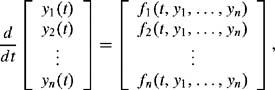
The most important term in this series is usually the one involving J, the Jacobian. For a system of differential equations with n components,
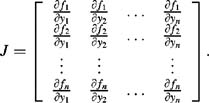
the Jacobian is an n-by- n matrix of partial derivatives:
The influence of the Jacobian on the local behavior is determined by the solution to the linear system of ordinary differential equations
Let ? k = ? k + i ? k be the eigenvalues of J and ? = diag( ? k) the diagonal eigenvalue matrix. If there is a linearly independent set of corresponding eigenvectors V, then
The linear transformation
transforms the local system of equations into a set of decoupled equations for the individual components of x:
The solutions are
A single component x k(t) grows with t if ? k is positive, decays if ? k is negative, and oscillates if ? k is nonzero. The components of the local solution y(t) are linear combinations of these behaviors.
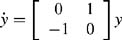
For example, the harmonic oscillator
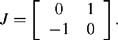
is a linear system. The Jacobian is simply the matrix
The eigenvalues of J are i and the solutions are purely oscillatory linear combinations of e it and


 TABLE OF CONTENTS