7.8 Lorenz Attractor
One of the world's most extensively studied ordinary differential equations is the Lorenz chaotic attractor. It was first described in 1963 by Edward Lorenz, and M.I.T. mathematician and meteorologist who was interested in fluid flow models of the earth's atmosphere. An excellent reference is a book by Colin Sparrow [54].
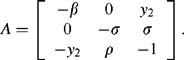
We have chosen to express the Lorenz equations in a somewhat unusual way involving a matrix-vector product:
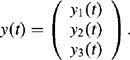
The vector y has three components that are functions of t:
Despite the way we have written it, this is not a linear system of differential equations. Seven of the nine elements in the 3-by-3 matrix A are constant, but the other two depend on y 2 (t):
The first component of the solution, y 1 (t), is related to the convection in the atmospheric flow, while the other two components are related to horizontal and vertica temperature variation. The parameter ? is the Prandtl number, ? is the normalized Rayleigh number, and ? depends on the geometry of the domain. The most popular values of the parameters, ? = 10, ? = 28, and ? = 8/3, are outside the ranges associated with the earth's atmosphere.
The deceptively simple nonlinearity introduced by the presence of y 2 in the system matrix A changes everything. There are no random aspects to these equations, so the solutions y(t) are completely determined by the parameters and the initial...


 TABLE OF CONTENTS