Numerical Methods for Chemical Engineering: Applications in MATLAB

Written in a pedagogic style, this textbook unites the applications of numerical mathematics and scientific computing to the practice of chemical engineering.
 TABLE OF CONTENTS
 This chapter discusses the solution of sets of linear algebraic equations and defines basic vector/matrix operations. The focus is upon elimination methods such as Gaussian elimination, and the related LU and Cholesky factorizations. Following a discussion of these methods, the existence and uniqueness of solutions are considered. Example applications include the modeling of a separation system and the solution of a fluid mechanics boundary value problem. The latter example introduces the need for sparse-matrix methods and the computational advantages of banded matrices. Because linear algebraic systems have, under well-defined conditions, a unique solution, they serve as fundamental building blocks in more-complex algorithms. Thus, linear systems are treated here at a high level of detail, as they will be used often throughout the remainder of the text.
We wish to solve a system of N simultaneous linear algebraic equations for the N unknowns x 1, x 2, , x N, that are expressed in the general form
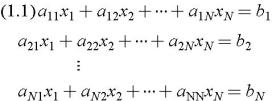
a ij is the constant coefficient (assumed real) that multiplies the unknown x j in equation i. b i is the constant right-hand-side coefficient for equation i, also assumed real. As a particular example, consider the system
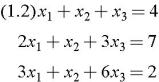
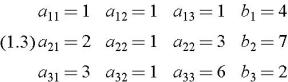
for which
It is common to write linear systems in matrix/vector form as

where
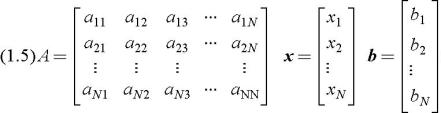
Row i of A contains the values a i 1, a i 2, , a iN that...