Numerical Methods for Chemical Engineering: Applications in MATLAB

Written in a pedagogic style, this textbook unites the applications of numerical mathematics and scientific computing to the practice of chemical engineering.
 TABLE OF CONTENTS
 The approximate posterior density ?( ?, ? y) for single-response data (8.116), describes the joint uncertainty in both ? and ?. Of more interest is the marginal posterior density for ?,

This is the posterior for ?, without regard to the exact value of ?. As we discard ? by integrating it out, it is called a nuisance parameter.
For the approximate posterior (8.116), the marginal posterior density can be calculated analytically,

Note again that for a linear model, this marginal posterior is exact.
We now form confidence intervals for the model parameters and the predicted responses using this approximate marginal distribution. First, it is best to consider the simple model (8.104), y [ k ] = ? + ? [ k ]. After N measurements, the posterior density is

where the sample mean and sample variance are

The marginal posterior density for ? is

Defining the t-statistic,
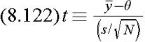
whose distribution satisfies p( t ?) dt = p( ? y) d ?, we have

This is the famous t-distribution of Student, a pseudonym for W. S. Gosset ( Gosset, 1908). As the number of degrees of freedom ? approaches infinity, the t-distribution reduces to a
Gaussian (normal) distribution of mean zero and variance 1:

For finite...