Numerical Methods for Chemical Engineering: Applications in MATLAB

Written in a pedagogic style, this textbook unites the applications of numerical mathematics and scientific computing to the practice of chemical engineering.
 TABLE OF CONTENTS
 We vary ? until the model predictions ? [ k ]( ?) agree most closely with the observed y [ k ]. We must define what we mean by close agreement, but a readily apparent choice of metric is that we select the value ? LS that minimizes the sum of squared errors

That is,

Substituting ?( ?) = X ? yields

Taking the derivative with respect to ?,

and setting it equal to zero yields a linear system for ? LS,

X T X is a P P matrix; its size is governed by the number of fitted parameters. The ( i, j) element of X T X is
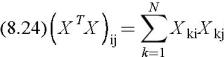
As we increase the number of experiments N, the magnitudes of the elements of X T X increase. X T X contains information about the ability of the experimental design to probe the parameter values. X T X is a real, symmetric matrix that is at least positive-semidefinite. For a well-designed set of experiments that provides sufficient data to estimate each parameter to at least some finite accuracy, X T X is positive-definite.
Often, X T X may be ill conditioned, i.e., it has one or more eigenvalues near zero, when the experimental design does not provide sufficient information to measure well one or more linear combinations of parameters. Therefore,