Numerical Methods for Chemical Engineering: Applications in MATLAB

Written in a pedagogic style, this textbook unites the applications of numerical mathematics and scientific computing to the practice of chemical engineering.
 TABLE OF CONTENTS
 We now resume our discussion of linear algebra, which previously focused upon the solution of linear systems A x = b by Gaussian elimination. The interpretation of A as a linear transformation was found useful in understanding the existence and uniqueness of solutions. Here, we consider a powerful tool in analyzing the transformational properties of a matrix, eigenvalue analysis, based upon identifying for a matrix A the eigenvectors w and corresponding scalar eigenvalues ? such that

We shall encounter numerous situations in which eigenvalue analysis provides insight into the behavior and performance of an algorithm, or is itself of direct use, as when estimating the vibrational frequencies of a structure or when calculating the states of a system in quantum mechanics. The related method of singular value decomposition (SVD), an extension of eigenvalue analysis to nonsquare matrices, is also discussed.
We begin our discussion of eigenvalue analysis by demonstrating how it may be used to diagnose the transformational properties of a matrix. Here, we consider a 3 3 real matrix Q that rotates vectors in  3. We specify the particular rotation that it performs by designating an orthonormal basis set { u [1], u [2], u [3]} that is obtained from the orthonormal basis
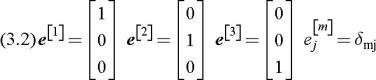
by transformation under Q (Figure 3.1),

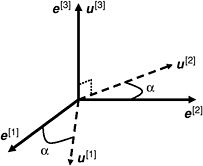
Note that we rotate the vectors, not the coordinate system. We...