Numerical Methods in Engineering with MATLAB
Solve the simultaneous equations Ax = b
In this chapter we look at the solution of n linear, algebraic equations in n unknowns. It is by far the longest and arguably the most important topic in the book. There is a good reason for this it is almost impossible to carry out numerical analysis of any sort without encountering simultaneous equations. Moreover, equation sets arising from physical problems are often very large, consuming a lot of computational resources. It usually possible to reduce the storage requirements and the run time by exploiting special properties of the coefficient matrix, such as sparseness (most elements of a sparse matrix are zero). Hence there are many algorithms dedicated to the solution of large sets of equations, each one being tailored to a particular form of the coefficient matrix (symmetric, banded, sparse, etc.). A well-known collection of these routines is LAPACK- Linear Algebra PACKage, originally written in Fortran77 [1].
We cannot possibly discuss all the special algorithms in the limited space available. The best we can do is to present the basic methods of solution, supplemented by a few useful algorithms for banded and sparse coefficient matrices.
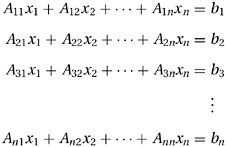
A system of algebraic equations has the form
| (2.1) | |
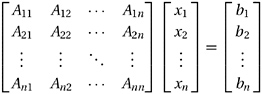
where the coefficients A ij and the constants b j are known, and x i represent the unknowns. In matrix notation the equations are written as
| (2.2) | |
or, simply
| (2.3) | |
A particularly useful representation of the equations for computational purposes...