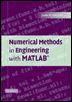
Numerical Methods in Engineering with MATLAB
2.4: Symmetric and Banded Coefficient Matrices

2.4 Symmetric and Banded Coefficient Matrices

Introduction

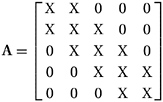
Engineering problems often lead to coefficient matrices that are sparsely populated, meaning that most elements of the matrix are zero. If all the nonzero terms are clustered about the leading diagonal, then the matrix is said to be banded. An example of a banded matrix is


where X s denote the nonzero elements that form the populated band (some of these elements may be zero). All the elements lying outside the band are zero. The matrix shown above has a bandwidth of three, since there are at most three nonzero elements in each row (or column). Such a matrix is called tridiagonal.

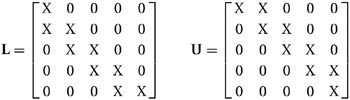
If a banded matrix is decomposed in the form A= LU, both L and U will retain the banded structure of A. For example, if we decomposed the matrix shown above, we would get


The banded structure of a coefficient matrix can be exploited to save storage and computation time. If the coefficient matrix is also symmetric, further economies are possible. In this article we show how the methods of solution discussed previously can be adapted for banded and symmetric coefficient matrices.

Tridiagonal Coefficient Matrix

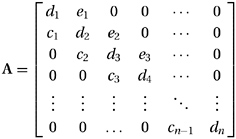
Consider the solution of Ax= b by Doolittle s decomposition, where A is the n n tridiagonal matrix


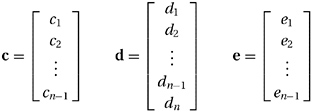
As the notation implies, we are storing the nonzero elements of A in the vectors


The resulting saving of storage can be significant. For example, a...

UNLIMITED FREE
ACCESS
TO THE WORLD'S BEST IDEAS

SUBMIT
Already a GlobalSpec user? Log in.

This is embarrasing...

An error occurred while processing the form. Please try again in a few minutes.

Customize Your GlobalSpec Experience

Category: Commercial Matrix Displays
Finish!
Privacy Policy

This is embarrasing...

An error occurred while processing the form. Please try again in a few minutes.