Numerical Methods in Engineering with MATLAB
The Taylor series expansion of a function ( x) about the point x=a is the infinite series
| (A1) | |
In the special case a = 0 the series is also known as the MacLaurin series. It can be shown that the Taylor series expansion is unique in the sense that no two functions have identical Taylor series.
A Taylor series is meaningful only if all the derivatives of ( x) exist at x=a and the series converges. In general, convergence occurs only if x is sufficiently close to a; i.e., if x ?a ??, where ? is called the radius of convergence. In many cases ? is infinite.
Another useful form of the Taylor series is the expansion about an arbitrary value of x:
| (A2) | |
Since it is not possible to evaluate all the terms of an infinite series, the effect of truncating the series in Eq. (A2) is of great practical importance. Keeping the first n+1 terms, we have
| (A3) | |
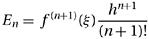
where E n is the truncation error (sum of the truncated terms). The bounds on the truncation error are given by Taylor's theorem:
| (A4) | |
where ? is some point in the interval ( x, x+ h). Note that the expression for E n is identical to the first discarded term of the series, but with x replaced by