OFDM for Wireless Communications Systems

In this practical resource, established and new technologies are explained clearly and comprehensively, from OFDM basics to a detailed account of a new technique, hybrid OFDM CDMA slow frequency hopping.
 TABLE OF CONTENTS
 This section discusses the various multiple-access schemes along with frequency-time diagrams and examines in detail the proposed scheme with its advantages over existing schemes.
One of the candidates for a large data-rate modulation scheme is OFDM. In such systems very high data rates are converted to very low parallel-data rates using a series-to-parallel (S/P) converter. This ensures flat fading for all of the SCs; that is, a wideband signal becomes a packet of narrowband signals. This will automatically combat multipath effects, removing the need for equalizers and RAKE receivers. A variant of this approach was earlier introduced as MC-CDMA. This proposal envisages interfacing a DS-CDMA system with a system of orthogonal coding using Walsh coding [8-11]. We briefly examine the advantages and disadvantages of the prevailing systems before proceeding to examine the new proposal. It is pointed out that the advantages and disadvantages listed are not comprehensive, but only those relevant to this topic.
Figure 7.1(a) shows the frequency-time diagrams of the four types of access schemes. In Figure 7.1(a), the CDMA and CDMA-SFH diagrams are self-explanatory. The MC-CDMA and OFDM-CDMA, however, require some explanation.
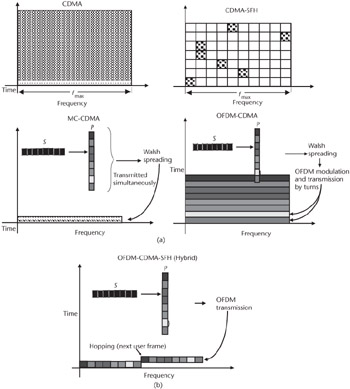
MC-CDMA: Suppose there is an 8-bit data "word." This word is then fed to a S/P converter. After this, each parallel bit is subjected to an 8-bit Walsh spreading using the code for that particular user in the FD. After...