OFDM for Wireless Communications Systems

In this practical resource, established and new technologies are explained clearly and comprehensively, from OFDM basics to a detailed account of a new technique, hybrid OFDM CDMA slow frequency hopping.
 TABLE OF CONTENTS
 An OFDM signal consists of a number of independently modulated SCs, which can give a large peak-to-average power (PAP) ratio when added up coherently. When N signals are added with the same phase, they produce a peak power that is N times the average power. This effect is illustrated in Figure 6.1. For this example, the peak power is 16 times the average value. The peak power is defined as the power of a sine wave with an amplitude equal to the maximum envelope value. Hence, an unmodulated carrier has a PAP ratio of 0 dB. An alternative measure of the envelope variation of a signal is the Crest factor, which is defined as the maximum signal value divided by the RMS signal value. For an unmodulated carrier, the Crest factor is 3 dB. This 3-dB difference between the PAP ratio and Crest factor also holds for other signals, provided that the center frequency is large in comparison with the signal bandwidth.
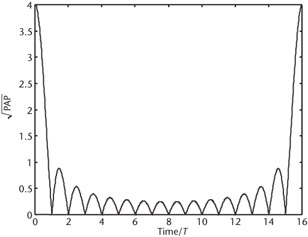
A large PAP ratio brings disadvantages like an increased complexity of the analog-to-digital (A/D) and digital-to-analog (D/A) converters and a reduced efficiency of the RF power amplifier. To reduce the PAP ratio, several techniques have been proposed, which basically can be divided in three categories. First, there are signal distortion techniques, which reduce the peak amplitudes simply by nonlinearly distorting the OFDM signal...