OFDM for Wireless Communications Systems

In this practical resource, established and new technologies are explained clearly and comprehensively, from OFDM basics to a detailed account of a new technique, hybrid OFDM CDMA slow frequency hopping.
 TABLE OF CONTENTS
 This section analyzes the behavior in a fading channel using realistic estimation. The simulations show that QPSK performs better, as it is more robust compared to 16-QAM. The hybrid system once again requires higher bandwidths. However, if BER is the predominant consideration, then the proposed system can be used by discarding the SFH part.
This aspect of the book is based on the work done by Tutucu [30]. A baseband model of an OFDM system using pilot-based signal correction is shown in Figure 7.31.
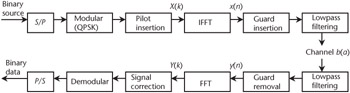
Binary information data is encoded in multiphase signals (QPSK/16-QAM). Then the pilot signals are uniformly inserted into the information data sequence. The function of the IFFT block is to convert the data sequence on length N into N parallel data, modulate it on N SCs, and sum them. After lowpass filtering, the modulated carrier is then transmitted. At the receiver, the pilot-based signal correction is performed after FFT, followed by decoding.
The total N SCs of the OFDM system are arranged as follows. Adjacent L ( L < N) are grouped together, without overlapping between adjacent groups. In each group, the first SC is used to transmit the pilot signal and thus is called the pilot SC. The rest of the SCs bear information data and thus are called information SCs. Therefore, there are a total...