Optical Rheometry of Complex Fluids

Chapter 1: Propagation of Electromagnetic Waves

The experimental methods presented in this monograph concern the interaction of light with complex materials for the purpose of elucidating aspects of structure and dynamics. The interactions range from simple transmission and reflection, to scattering and nonlinear responses. Measurement of changes in the properties of the light (polarization, intensity, or frequency) is used to infer the microstructural characteristics of the sample and for this reason, the basic nature of light propagation in macroscopic media must be understood. This chapter presents the basic field equations governing the propagation of electromagnetic waves and the boundary conditions by which they are constrained.

1.1 The Maxwell Equations

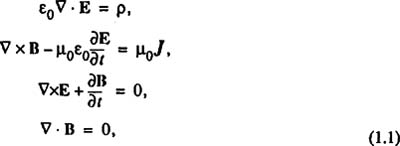
Electromagnetic waves combine the propagation of two vector fields, E and B. These are the electric and magnetic induction fields, respectively, and in a vacuum are governed by the Maxwell equations 1, 2, 3]:

where ? 0 and ? 0 are the permittivity and permeability of free space. The density of charges in the system, ?(x), and the current density, J (x), obey the following equation of continuity:

Equation (1.2) is not independent and is obtained by combining the first two equations in (1.1).

Light propagating within a medium will interact with the constituent molecules or particles and the induction fields E and B will be altered. In principle, the equations in (1.1) can be applied to any situation as long as the charge and current densities are specified. In a condensed media, however, this approach is not practical...

UNLIMITED FREE
ACCESS
TO THE WORLD'S BEST IDEAS

SUBMIT
Already a GlobalSpec user? Log in.

This is embarrasing...

An error occurred while processing the form. Please try again in a few minutes.

Customize Your GlobalSpec Experience

Category: Circular Polarizers
Finish!
Privacy Policy

This is embarrasing...

An error occurred while processing the form. Please try again in a few minutes.