Optical Rheometry of Complex Fluids

Chapter 6: Laser Doppler Velocimetry and Dynamic Light Scattering

The methods described in this book are primarily concerned with the measurement of the microstructure of complex fluids subject to the application of external, orienting fields. In the case of flow, it is also of interest to measure the kinematics of the fluid motion. This chapter describes two experimental techniques that can be used for this purpose: laser Doppler velocimetry for the measurement of fluid velocities, and dynamic light scattering (or photon correlation spectroscopy) for the determination of velocity gradients.

6.1 Laser Doppler Velocimetry

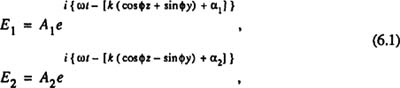
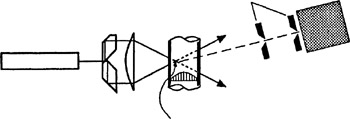
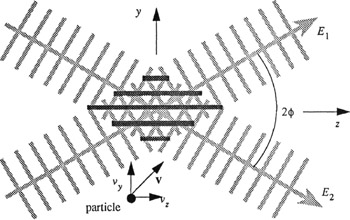
Laser Doppler velocimetry is a powerful technique for the in situ measurement of fluid velocities. The basic optical configuration for the measurement is shown in Figure 6.1. The velocity measurement is made at the intersection of two laser beams that are focused to a point in the flow. The use of laser radiation is essential since the light must be monochromatic and coherent. This is required since the intersection of the two beams must create an interference pattern within the fluid. Such a pattern is shown in Figure 6.2, where two plane waves intersect at an angle 2 ?. The two waves will have the following form [55]:

where ? i is a phase factor and A i is an amplitude.


Figure 6.1: Optical configuration for a laser Doppler velocimeter.

Figure 6.2: Fringe pattern formed by two intersecting plane waves.

The intensity of the combined beams in the intersection region is simply

if the two beams have the same phase ( ?

UNLIMITED FREE
ACCESS
TO THE WORLD'S BEST IDEAS

SUBMIT
Already a GlobalSpec user? Log in.

This is embarrasing...

An error occurred while processing the form. Please try again in a few minutes.

Customize Your GlobalSpec Experience

Category: Particle Analyzers
Finish!
Privacy Policy

This is embarrasing...

An error occurred while processing the form. Please try again in a few minutes.