Optical Rheometry of Complex Fluids

The design of an optical instrument begins with a consideration of the structural and dynamic information that is desired from a sample, and their relationship to its optical properties. This information must be combined with the particular flow or sample geometry that will be probed and the timescales of the dynamics to be monitored.
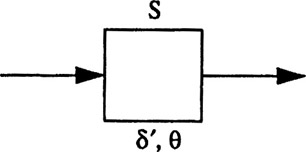
The optical arrangements presented in this chapter are presented according to whether the light is measured in transmission, or as scattered light. The latter category is further subdivided into small angle, wide angle, dynamic, and Raman scattering. Throughout this chapter, schematic diagrams will be offered that describe the various designs of instruments. The notation outlined in the following table is used to represent different optical elements in these figures. As an example, a typical element would be described as depicted in the following figure, where a birefringent sample of retardation ?? and orientation ? is shown. The symbols above the element refer to the type of device that is represented. Below the element are symbols describing its properties (the type of anisotropy and its angle of orientation in the optical train).
| Optical Element | Symbol |
|---|---|
| analyzing polarizer | A |
| beam splitter | B |
| circular polarizer | CP |
| detector | D |
| color filter | F |
| half-wave plate | H |
| light source | L |
| lens | LS |
| monochromator | M |
| notch filter | NF |
| polarization state analyzer | PSA |
| polarization state generator | PSG |
| polarizer | P |
| quarter-wave plate |