Optics of Quantum Dots and Wires
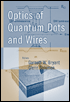
Quantum technology is the key to next-generation optoelectronics and laser semiconductors, and this cutting-edge book is an in-depth examination of how quantum dots and wires are fabricated and applied to optics.
 TABLE OF CONTENTS
 The longer diffusion length of the Ga species migrating toward the bottom of the V-groove due to the capillarity fluxes yields Ga-rich regions at the bottom facets [99, 100]. Qualitative evidence for the formation of such Ga-rich regions is provided by the TEM images of the V-groove AlGaAs structures (e.g., Figures 6.8, 6.12, and 6.13), which display dark vertical stripes running through the center of the groove. These dark vertical stripes represent extremely narrow (20 nm or less), Ga-rich AlGaAs sheets that can laterally confine charge carriers in a 2D QW geometry. The unusual vertical orientation of these QWs [see Figure 6.17(a)] is different from the horizontal one of conventional QW structures formed by layer deposition. These VQWs offer new possibilities in studies of low-dimensional systems and their applications. This section summarizes the structural and optical features of these self-ordered QW heterostructures.
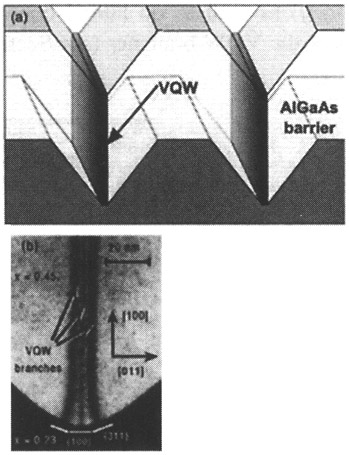
Figure 6.17(b) shows a TEM cross section of an Al 0.45Ga 0.55As layer grown in a self-limiting Al 0.23Ga 0.77As V-groove by low pressure OMCVD at T = 700 C [101]. Three branches of darker (and hence Ga-rich) AlGaAs regions are observed at the center of the groove, each associated with the (100) or a {311}A self-limiting nanofacet. The separation of the VQW branches follows the evolution...