Optics of Quantum Dots and Wires
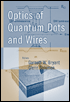
Quantum technology is the key to next-generation optoelectronics and laser semiconductors, and this cutting-edge book is an in-depth examination of how quantum dots and wires are fabricated and applied to optics.
 TABLE OF CONTENTS
 D. Bimberg, N. N. Ledentsov, M. Grundmann, and F. Heinrichsdorff
Institut f r Festk rperphysik, Technische Universit t Berlin
Berlin, Germany
V. M. Ustinov, P. S. Kop'ev, M. V. Maximov, and Zh. I. Alferov
A. F. Ioffe Physical Technical Institute
St. Petersburg, Russia
A recent breakthrough in modern semiconductor physics is related to the development of a new class of heterostructures self-organized quantum dots. These unique objects combine advantages of bulk semiconductors with those of single atoms. Significant improvements in the characteristics of injection lasers have been predicted for structures using quantum dots (QDs) as gain medium [1, 2]. If the dimension of a QD becomes comparable in all three dimensions to the de Broglie wavelength or the mean free path of elementary excitations in the crystal (if the latter is smaller), the density of states becomes a ?-function [3]. Thus, QDs provide the ultimate limit of size quantization in solids and an extremely large change of electronic properties as compared to quantum wells and wires. The ?-function-like density of states and strong confinement of electron and hole wavefunctions are unique properties of QDs, and are a basis for improved device characteristics. If, in addition, the separation between the lowest size quantization level exceeds several kT, no thermal or excitation dependent broadening of the gain function is possible. QD lasers with such an atomic-like density of states can show ultralow threshold current densities, ultrahigh temperature stability of threshold current, ultrahigh differential gain, and chirp-free operation under direct...