Optics of Quantum Dots and Wires
Quantum technology is the key to next-generation optoelectronics and laser semiconductors, and this cutting-edge book is an in-depth examination of how quantum dots and wires are fabricated and applied to optics.
 TABLE OF CONTENTS
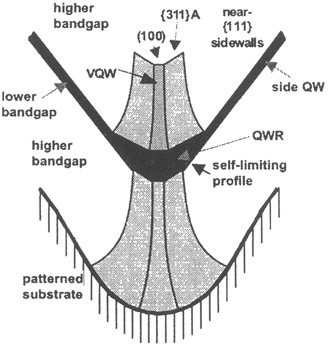
 The self-limiting V-groove profiles discussed in the previous sections can serve as seeds for the formation of QWRs and related heterostructures, owing to the characteristic evolution of growth on a nonplanar substrate described in Section 6.2. Starting from a self-limiting V-groove profile (e.g., Al xGa 1- xAs), and then switching to growth of a lower bandgap layer (e.g., Al yGa 1- y As, y < x), which is also characterized by a larger "effective" diffusion length, results in expansion of the nanofacets at the bottom of the groove. This is accompanied by a higher growth rate at the bottom facets. The result is the formation of a crescent-shaped, lower-bandgap structure, which can confine charge carriers in the lateral direction (see Figure 6.27). Capping the crescent with a higher bandgap material yields a buried QWR structure whose interfaces are all formed during growth, and are thus potentially defect-free. Notice that, in addition to the 3D barrier material surrounding the QWR crescent, 2D barriers are formed, due to the growth of the lower-bandgap layer on the sidewalls of the groove. In the case of an alloy barrier (e.g. AlGaAs), a 2D VQW barrier can also form above and below the wire. A complex 1D heterostructure confined by barriers of different dimensionalities is thus realized.