Photonics Rules of Thumb: Optics, Electro-Optics, Fiber Optics, and Lasers, Second Edition
The laser radar cross section of a cube corner retro-reflector exposed to an illuminating beam and viewed from the position of the source is
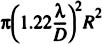
A retro-reflector will return a beam of light to the location of the illuminator. The diffraction-limited return beam half angle from a retro-reflector of diameter D is 1.22( ?/ D), so the beam fills an area of
for a circular retro at a distance R. The solid angle of the beam emitted by the retro is defined as the ratio of the area of its beam and the range squared so the solid angle is approximately 4.67( ? 2/ area). Cross section is defined as the area of the emitter divided by the solid angle of the beam it emits. Thus,
This rule applies to perfect "cube corner" retro-reflectors only. Occasionally, such devices will have a cross section that is slightly less as a result of less-than-unity reflection and less-than-perfect tolerances on the angles of the mirrors.
This rule gives an immediate estimate of the detectability of an object equipped with a retro-reflector. It also allows the reflector to be sized so that detection at an appropriate range and for a particular laser power can be estimated. Additionally, targets (even uncooperative ones) frequently have structures that approximate cube corners, giving them a much larger signature than would be assumed otherwise.
It is important that the user of this equation realize that the total efficiency...