Photonics Rules of Thumb: Optics, Electro-Optics, Fiber Optics, and Lasers, Second Edition
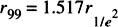
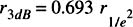
Hobbs [1] gives
| 1. |
|
| 2. |
|
| 3. |
|
| where | r 1/ e 2 | = radius where the intensity is decreased by 1/ e 2 compared to its size at the beam waist |
| NA | = numerical aperture = 1/2 f/# | |
| ? | = wavelength | |
| r 99 | = 99 percent of the power is included in a circle with this radius | |
| r 3dB | = 3-dB power density radius |
Laser spots emitted by low-numerical-aperture optics tend to be Gaussian.
The first equation is a simplification of ?/( ? NA). The factor of 2 comes from ?/ ?, which is 2 for a wavelength of 1.557 ?m.
Gaussian beams tend to be tighter than imaging spots with Airy disk patterns. Remember that the radius is in the same units as the wavelength, so if you use nanometers for the wavelength, the radius will be in nanometers as well.
Hobbs points out, "The Gaussian beam is a paraxial animal. It is hard to make a good one of high NA. The extreme smoothness of the Gaussian beam makes it exquisitely sensitive to vignetting (which of course becomes inevitable as sin ? approaches 1), and the slowly varying envelope approximation itself breaks down as the numerical aperture increases."
Just to prove that nobody agrees on anything, we quote from [2], in which the authors show that the diameter of a focused Gaussian spot is
| where | F | = focal length... |