Physics of Solid-State Lasers

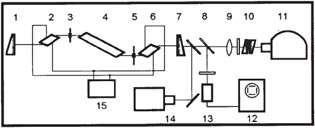
The main parameters of free lasing of solid-state lasers have been investigated on experimental equipment whose diagram is shown in Fig. 1.1. In development of equipment, all measures have been taken to eliminate the effect of technical perturbations of the resonator on the free lasing dynamics. All optical elements of the resonator are placed on very rigid and thick tables with mechanisms for precision angular and linear displacement.
The spurious selection of longitudinal modes in the resonator was completely eliminated: the ends of all elements of the resonator were cut either under the Brewster angle or under a small angle in relation to the axis of the resonator (in the latter case, the ends of the elements were trans-illuminated); the mirrors of the resonator were sprayed on glass substrates with a wedge; the diaphragms, separating the longitudinal modes, were coated with a lacquer. The active media of the lasers were cooled with distilled water or a liquid filter cutting off the ultraviolet radiation of pumping. The temperature of the cooling liquid was maintained with a thermostat with the accuracy to 0.1 C. The active media were excited with...