6.1 QUANTUM KINETIC EQUATION FOR THE DENSITY MATRIX
In a semiclassic approximation in which the quantum fluctuations of the radiation field are ignored, the resonance interaction of the atom (or molecule) with the electromagnetic wave E( r, t) can be described by the Schr dinger equation
| (6.1) | 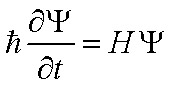
|
for the wave function ?( r, ?, t), where r is radius-vector of the centre of inertia of the particles; ? is the population of its internal co-ordinates. The particle energy is determined by the eigenvalues of the Hamiltonian
| (6.2) | 
|
which is represented by the sum of the operator of the energy of the non-perturbed electron shell and the operator of interaction with external fields ? V ( r, ?, t).
In the statistical examination of the effect of the environment on the examined system, it is efficient to transfer from the wave function to the density matrix
| (6.3) | 
|
which makes it possible to describe by a simple procedure the completely and partially defined quantum mechanics state.
The Neuman equation for the density matrix
| (6.4) | 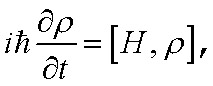
|
obtained from (6.1) is, as is well known, the most general form of the quantum mechanics description of the evolution of different systems [1,2]. In accordance with the principles of quantum theory, the calculations of the mean quantum mechanics values of the physical quantities are carried out using the equation
| (6.5) | 
|
where is the operator corresponding to quantity A.
When describing the interaction...


 TABLE OF CONTENTS