Physics of Solid-State Lasers

Chapter 7: Stochastic and Transition Processes in Solid-State Lasers

7.1 STATISTICAL MODELLING OF LASING

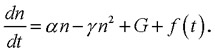
The lasing properties of solid-state lasers are determined to a large degree by stochastic processes which have been the subject of special attention in recent years [1,2]. In this chapter, we examine the statistical model of the transition processes in lasing. The initial and non-linear stages of lasing are analysed in detail. A dependence is found between the lasing conditions and the fluctuations of the time of realisation of the transition process. In the approximation of weak saturation, the stochastic behaviour of lasing can be stimulated using the Langevin equation for the total number of lasing photons in the unit volume n, having the form [3,4]:

(7.1)

Here G is the mean value of the lasing rate; f( t) is the part of the rate of lasing fluctuating in a random manner. In the stochastic non-linear differential equation (7.1), the function f( t) describes the ?-correlated random process, determining the properties of the latter in a Langevin source of fluctuations [3 5]:

(7.2)

The origin of these fluctuations is determined by the fact that the photons can be excited by non-equilibrium radiation, and also in the absorption of the quanta of vibrations of the lattice (phonons) and of the photons of thermal radiation which are in thermal equilibrium with the active medium. The region of applicability of the balance equation (7.1) for the concentration of the photons is restricted by the limits of taking into account only the linear...

UNLIMITED FREE
ACCESS
TO THE WORLD'S BEST IDEAS

SUBMIT
Already a GlobalSpec user? Log in.

This is embarrasing...

An error occurred while processing the form. Please try again in a few minutes.

Customize Your GlobalSpec Experience

Category: Solid State Lasers
Finish!
Privacy Policy

This is embarrasing...

An error occurred while processing the form. Please try again in a few minutes.