Principles of Robot Motion: Theory, Algorithms, and Implementation

Many sensor-based techniques, such as those in sections 2.3.3 and 5.2.5, are essentially curve-tracing algorithms. In both cases, the robot is, in a sense, "determining" the curve as it is being traced. Such techniques relied on two fundamental principles: the curve being traced exists and under the "right conditions," the curve can be traced with simple predictor-corrector techniques. These principles rested on two theorems, the implicit function theorem, and the Newton-Raphson convergence theorem, described below.
Consider a smooth function of multiple variables, f( x, y), and consider the surface that is defined by the equation f( x, y) = z 0 for some fixed z 0. Under certain conditions, this surface can be used to write a new function that defines the y variables in terms of the x variables, i.e., y = g( x, z 0). The theorem that states these conditions is called the implicit function theorem.
Let
be a smooth vector-valued function, f( x, y). Assume that D yf( x 0, y 0) is invertible for some
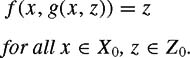
. Then there exist neighborhoods X 0 of x 0 and Z 0 of f( x 0, y 0) and a unique, smooth map
such that
By numerically following the set of points where f( x, y) = 0,...