Principles of Robot Motion: Theory, Algorithms, and Implementation

Appendix J: Linear Systems and Control

This Appendix gives a brief review of the theory of linear time invariant (LTI) dynamical systems. Many dynamical systems that appear in science and engineering can be approximated by LTI systems, and linear systems theory provides important tools to control and observe them. We focus on the so-called state space formulation of LTI systems because that is the formulation used in the Kalman filter (see chapter 8). In this appendix we present some of the more fundamental concepts of LTI state-space systems, including stability, feedback control, and observability.

J.1 State Space Representation

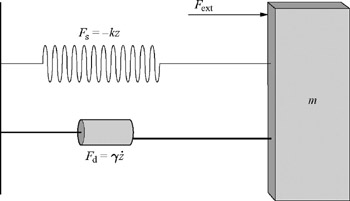
Consider as an example the mass-spring-damper system depicted in figure J.1, where z( t) denotes the position of the mass m at time t. If we assume that the spring is linear, then the force applied by the spring is given as F s = ? kz( t). Likewise, if we assume that the damper is linear, then the force applied by the damper is proportional to the velocity of the mass, yielding . For now we assume the externally applied force F ext = 0. Summing these forces and applying Newton's law (force = mass acceleration) yields

(J.1)

Figure J.1: Mass spring damper system.

This second-order ordinary differential equation (ODE) provides a mathematical description of how the position and velocity of mass change with time. Accordingly, we call equation (J.1) a model of the mass-spring-damper system. If the position z and velocity ? are known at...

UNLIMITED FREE
ACCESS
TO THE WORLD'S BEST IDEAS

SUBMIT
Already a GlobalSpec user? Log in.

This is embarrasing...

An error occurred while processing the form. Please try again in a few minutes.

Customize Your GlobalSpec Experience

Category: Rotary Dampers
Finish!
Privacy Policy

This is embarrasing...

An error occurred while processing the form. Please try again in a few minutes.