Principles of Spread-Spectrum Communication Systems
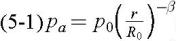
Free-space propagation losses of electromagnetic waves vary inversely with the square of the distance between a transmitter and a receiver. Analysis indicates that if a signal traverses a direct path and combines in the receiver with a mul-tipath component that is perfectly reflected from a plane, then the composite received signal has a power loss proportional to the inverse of the fourth power of the distance. Thus, it is natural to seek a power-law variation for the average received power in a specified geographic area as a function of distance. For terrestrial wireless communications, measurements averaged over many different positions of a transmitter and a receiver in a specified geographic area confirm that the average received power, which is called the area-mean power, does tend to vary inversely as a power of the transmitter-receiver distance r. It is found that the area-mean power is approximately given by
where p 0 is the average received power when the distance is r = R 0, and ? is the attenuation power law. The parameters p 0 and ? are functions of the carrier frequency, antenna heights, terrain characteristics, vegetation, and various characteristics of the propagation medium. Typically, the parameters vary with distance, but are constant within a range of distances. A typical value of the attenuation power law for urban areas and microwave frequencies is ? = 4. The power law increases with the carrier frequency.