C.1 Bandpass Signals
The Hubert transform provides the basis for signal representations that facilitate the analysis of bandpass signals and systems. The Hilbert transform of a real-valued function g(t) is
Since its integrand has a singularity, the integral is defined as its Cauchy principal value:
provided that the limit exists. Since (C-1) has the form of the convolution of g(t) with l/ ?( t),  results from passing g(t) through a linear filter with an impulse response equal to 1/ ? t. The transfer function of the filter is given by the Fourier transform
where  This integral can be rigorously evaluated by using contour integration. Alternatively, we observe that since 1/ t is an odd function,
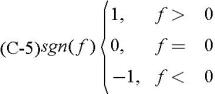
where sgn( ) is the signum function defined by
Let G(f) = F{g(t)}, and let  . Equations (C-1) and (C-4) and the convolution theorem imply that
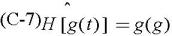
Because  results from passing g(t) through two successive filters, each with transfer function ?j sgn( ),
provided that G(0) = 0.
Equation (C-6) indicates that taking the Hilbert transform corresponds to introducing a phase sift of ?? radians for all positive frequencies and + ? radians for all negative frequencies. Consequently,
These relations can be formally verified by taking the Fourier transform of the left-hand side of (C-8) or (C-9), applying (C-6), and then taking the inverse Fourier transform of the result. If G( )


 TABLE OF CONTENTS