Printed Circuit Boards

Written by a world-renowned electronics expert, this reader-friendly guide helps engineers and technicians solve issues in PCB layout, fabrication, assembly, and testing.
 TABLE OF CONTENTS
 Electronic equipment is a combination of electrical and electronic components connected to produce a certain designed function. In the era of vacuum tubes and even later, electronic equipment was constructed by hand wiring and by point-to-point soldering. The wires were stripped of their insulation, tinned and soldered. Each discrete component was installed by hand, electrically and mechanically. The equipment was obviously large, awkward and bulky. It was difficult to meet the demanding requirements for the use of this equipment in aircrafts, the health sector and home emergency uses, thereby necessitating the development of smaller and more compact electronic equipment.
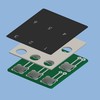
A natural evolution took place in several areas. Smaller components were developed and modular design became popular, basically intended to decrease the time between unit failure and repair due to easy replaceability. The use of miniaturization and sub-miniaturization in electronic equipment design gave birth to a new technique in inter-component wiring and assembly that is popularly known as the printed circuit board. The printed circuit board provides both the physical structure for mounting and holding electronic components as well as the electrical interconnection between components.
Printed circuit board is usually abbreviated as PCB and quite often referred to as board. However, in the USA, the term PWB ( Printed Wiring Board) is more often used instead of PCB.
There are many good reasons for using printed circuit boards instead of other interconnection wiring methods and component mounting...