Printed Circuit Boards

Written by a world-renowned electronics expert, this reader-friendly guide helps engineers and technicians solve issues in PCB layout, fabrication, assembly, and testing.
 TABLE OF CONTENTS
 The soldering process basically includes an understanding of:
Soldering material (solder and flux);
Soldering tools; and
Soldering procedure.
Following is a description of each of these topics:
The soldering material or solder usually employed for the purpose of joining together two or more metals at temperatures below their melting point is a fusible alloy consisting essentially of lead (37%) and tin (63 %). It may sometimes contain varying quantities of antimony, bismuth, silver or cadmium which are added to vary the physical properties of the alloy.
The continuous connection between two metals is secured by soft solder by virtue of a metal solvent or inter-metallic solution action that takes place at a comparatively low temperature. Figure 13.2 is a phase diagram which shows the relationship between temperature and physical state i.e. it shows the tin-lead fusion diagram which explains the alloy or solvent action on molten solder. Pure lead melts at 327 C while pure tin melts at 232 C.
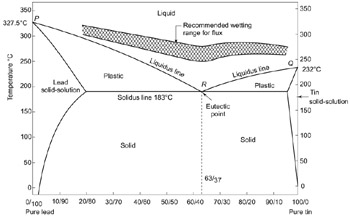
When tin is added to lead, the melting point of lead gets lowered and follows the line PR. Similarly, when lead is added to tin, its melting temperature falls along QR. At point R where the two lines PR and QR meet, an alloy of lowest melting point is obtained. The point 'R' represents 63 per cent tin and 37 per cent lead. The alloy at this point is known to have eutectic composition and...