Real Process Improvement Using the CMMI
I m not asking you what you do, Dave. I m asking you who you are.
Jack Nicholson as Dr. Buddy Rydell in Anger Management [50]
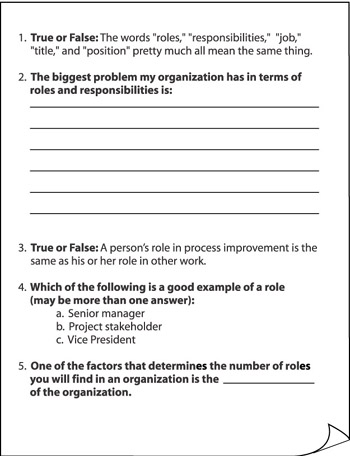
This chapter is about defining the roles of people in the organization and the roles of organizations which work together to deliver a system or service. As you will soon learn, it is very easy to make assumptions about roles and responsibilities in an organization. If left unchallenged like comparing your assumptions with reality the assumptions will soon become hard-held beliefs. Take the quiz in Figure 2.1 to see what kinds of beliefs you may have about organizational roles and then, after reading the chapter, take the quiz in Figure 2.3 to find out what you ve learned.
[50]Segal, Peter, Anger Management, Sony Pictures, 2003.
Both SW-CMM and CMMI provide either explicit or implicit guidance for establishing roles and responsibilities in the organization. In SW-CMM, there are Ability to Perform key practices that address establishing certain functions to perform processes and activities such as project management, change control, quality assurance, and training. In CMMI, there are no explicit practices that come right out and say, define your roles and responsibilities, but there are several GPs that heavily depend on some level of established roles. GP 2.3 requires that resources be provided for performing the process, developing the...