Reliability Engineering Handbook, Volume 1

Chapter 8: The Lognormal Distribution

8.1 LOGNORMAL DISTRIBUTION CHARACTERISTICS

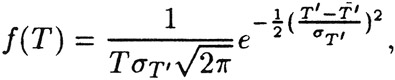
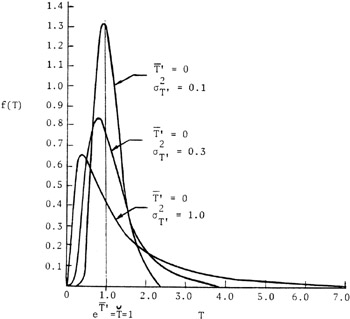
The two-parameter lognormal distribution, illustrated in Figs. 8.1(a) and (b), is given by [1]

(8.1)

f( T) ? 0, T ? 0, - ? < T' < ?, ? T , > 0,

(8.2)

where

T'

=

mean of the Naperian or natural logarithms of the times to failure, log e hr,

and

? T

=

standard deviation of the Naperian or natural logarithms of the times to failure, log e hr.

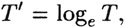
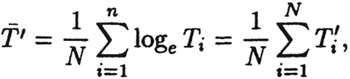
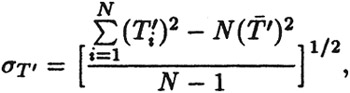
A random variable is lognormally distributed if the logarithm of the random variable is normally distributed. It is for this reason that Eq. (8.1) has its two parameters, T' and ? T', in terms of the logarithms of the data, values. These parameters are determined as follows:

(8.3)

and

(8.4)

8.1 a: The plot of the lognormal distribution for a fixed value of T' and various of [2, p. 98]. "Reprinted by permission of John Wiley & Sons, Inc."

where N is the total number of measurements made or of the time-to-failure data obtained. Furthermore, to find reliabilities, areas under the pdf have to be determined by integration. But the lognormal pdf is not exactly and directly integrable, whereas the areas under the standardized normal pdf have been tabulated. As a lognormal pdf can be transformed to a normal pdf through the transform log eT = T', and the parameters of this...

UNLIMITED FREE
ACCESS
TO THE WORLD'S BEST IDEAS

SUBMIT
Already a GlobalSpec user? Log in.

This is embarrasing...

An error occurred while processing the form. Please try again in a few minutes.

Customize Your GlobalSpec Experience

Category: Opacity Sensors and Instruments
Finish!
Privacy Policy

This is embarrasing...

An error occurred while processing the form. Please try again in a few minutes.