Reporting Results: A Practical Guide for Engineers and Scientists

Statistical Analysis of Experimental Data

A very simple method of describing the uncertainty is to specify the range as the average of the extreme positive and negative deviations about the arithmetic mean. However, this description depends on the number of measurements. With just a few measurements, there is a strong possibility that the next measurement will fall outside this specified range. There is no statistical method to calculate these odds. Thus, the uncertainty should define the frequency distribution, or dispersion, of the data.

Standard Deviation

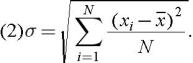
The most common measure of dispersion in experimental data is the standard deviation, ?. Sometimes called the biased standard deviation, it applies to a large number of individual tests and is calculated thus:


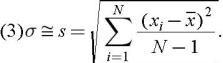
If the number of measurements, N, is small (fewer than 20), then Bessel s approximation for ? can be used and the result is an unbiased or sample standard deviation, s, given by


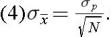
It is sometimes useful to define a standard error for the mean value, ? x. If the dispersion of the individual measurements, ? p, is known, then the standard error for the mean value, ? x, may be calculated as


Typically, ? p is unknown because many measurements are required to determine if the population is Gaussian or is described by another statistical distribution, such as Weibull statistics. An estimate for ? x may be obtained using ?, the standard deviation.

The dependence of yield...

UNLIMITED FREE
ACCESS
TO THE WORLD'S BEST IDEAS

SUBMIT
Already a GlobalSpec user? Log in.

This is embarrasing...

An error occurred while processing the form. Please try again in a few minutes.

Customize Your GlobalSpec Experience

Category: LiDAR Sensors
Finish!
Privacy Policy

This is embarrasing...

An error occurred while processing the form. Please try again in a few minutes.