Reporting Results: A Practical Guide for Engineers and Scientists
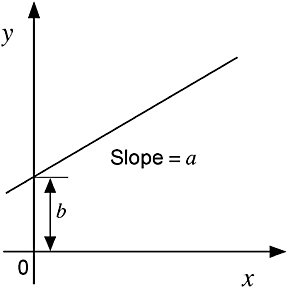
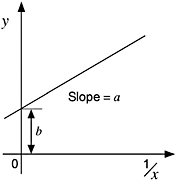
Plotting experimental data on scales chosen so that the theory gives a straight line allows one to find constants in mathematical expressions. For example, if data are to be fitted to y = ax + b in a plot (see Figure A.1) of y vs. x, b is the value of y at x = 0 and a is the slope.
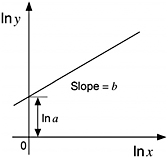
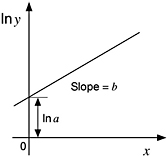
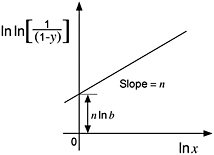
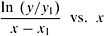
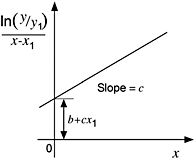
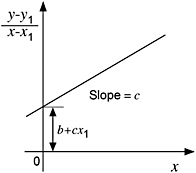
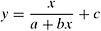
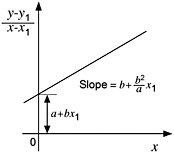
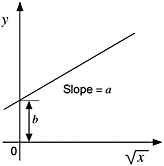
The following examples are adapted from the fifth edition (1989) of J. P. Holman s book Experimental Methods for Engineers. All of the plotting methods produce a straight line on linear scales and thus facilitate least-squares fitting routines to determine a best-fit straight line. In some of the examples the first paired points ( x 1, y 1) are used in plotting the ordinate values.
| Function | Plot | Graph |
|---|---|---|
| y = ax b | In y vs. In x | |
| y = a exp( bx) | In y vs. x | |
| y = 1 ? exp ? ( bx) n | | |
| y = a exp ( bx + cx 2) | | |
| y = a + bx + cx 2 | | |
| | | |
| | | |
| | | |
| | | |