Reporting Results: A Practical Guide for Engineers and Scientists

Uncertainty Analysis

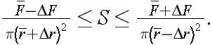
It is sometimes necessary to transform experimental data and the corresponding uncertainty by a mathematical operation to obtain a desired engineering result. A typical example would be the measurement of a stress. During a tensile test the load, F, rather than the stress, S, is actually measured and must be converted to a stress by dividing by the crosssectional area, ?r 2. Uncertainty in the stress value is introduced as a result of errors in measuring the sample radius, r, and errors in measurement of the load. Converting these errors to an uncertainty in the stress can be accomplished in a number of ways. A commonsense approach is to combine all of the errors in the most detrimental way to determine the minimum and maximum values that might be obtained. The following is an example of this approach for calculating the stress:


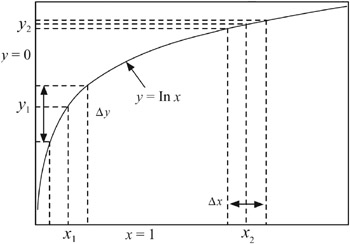
A more precise method for calculating uncertainties was developed by Kline and McClintock (1953). To illustrate how this method was formulated, consider the relationship between y and x when they are related by the equation y = ln x; see Figure 6.8.


Figure 6.8: A schematic drawing that illustrates how the uncertainty in the x variable may be converted to an uncertainty in the y variable via a mathematical transformation. In this case y is related to x through the equation y = ln x.

The ? y uncertainty will depend on the value of x,...

UNLIMITED FREE
ACCESS
TO THE WORLD'S BEST IDEAS

SUBMIT
Already a GlobalSpec user? Log in.

This is embarrasing...

An error occurred while processing the form. Please try again in a few minutes.

Customize Your GlobalSpec Experience

Category: Mechanical Testing Services
Finish!
Privacy Policy

This is embarrasing...

An error occurred while processing the form. Please try again in a few minutes.